
Private Label, Kids-Safe Range: Scope and Quality Checkpoints
On a private label kids-safe range, the brand owns the label but not the formula, the pack may come from the partner's existing library, and that division is exactly where quality expectations go wrong. Quality is not something a factory has or lacks in the abstract; it is a set of checkpoints that either sit inside the agreed scope or fall outside it. The buyer's job is to write the checkpoints into the scope, name the evidence that closes each one, and say who signs.
Key takeaways
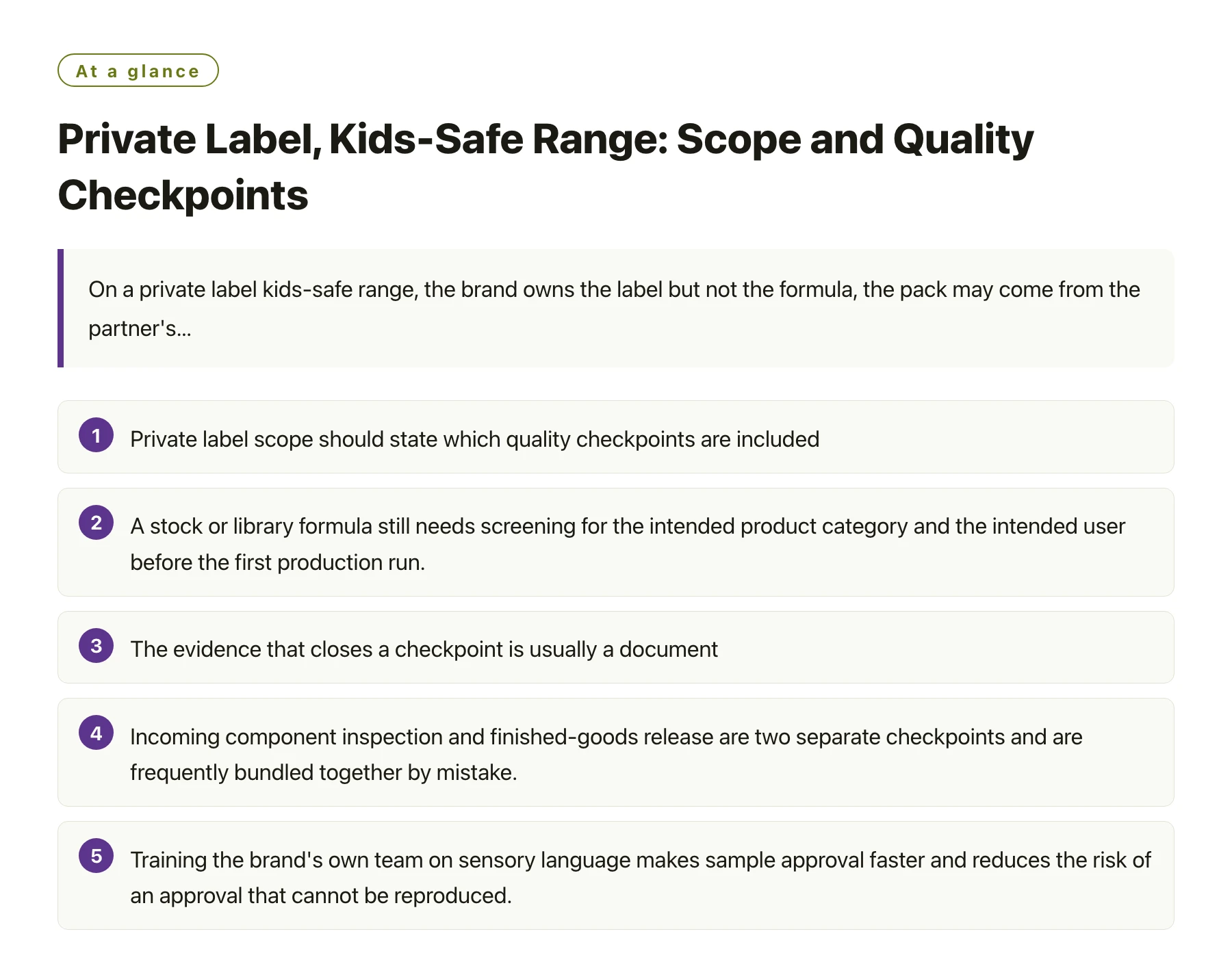
- Private label scope should state which quality checkpoints are included, because anything unlisted defaults to nobody's responsibility at the moment it matters.
- A stock or library formula still needs screening for the intended product category and the intended user before the first production run.
- The evidence that closes a checkpoint is usually a document, a retained sample or a signed approval, not a verbal assurance on a call.
- Incoming component inspection and finished-goods release are two separate checkpoints and are frequently bundled together by mistake.
- Training the brand's own team on sensory language makes sample approval faster and reduces the risk of an approval that cannot be reproduced.
Retailers and small brands choose private label for a specific reason: it removes development time. The scent comes from a library, the pack may already exist, and the first order arrives sooner than a full custom programme would allow.
That trade is reasonable, but it moves the buyer's attention from creating the product to specifying the service. On a kids-safe range, the specification has to be unusually explicit, because the standard the product must meet depends on who it is for, and that information only travels if it is written down.
Quality checkpoints across a private label kids-safe run
| Stage | Checkpoint | What closes it |
|---|---|---|
| Scent selection | The library formula is confirmed as suitable for the intended product category and user, not just for the brand's market segment | A written screening record against the applicable standards, issued for the selected formula revision |
| Formula handover | The exact revision, dosage and any customer-specific adjustment are recorded and frozen before bulk production | A signed formula specification with a revision number and a date |
| Incoming components | Bottles, closures, pumps and cartons are inspected against the approved specification on receipt | An incoming inspection record with sample size, defect definitions and the disposition of any reject |
| Bulk compounding | Batch weights, mixing order and resting time follow the agreed process rather than operator habit | Batch record signed by the compounding operator and countersigned |
| Filling and assembly | Fill weight, crimp dimensions, leak checks and label placement are verified during the run, not only at the end | In-process check sheet with the interval stated and the results recorded at each interval |
| Finished goods release | The batch is compared against the retained approved standard before it is packed for shipment | A release note naming the comparison sample and the person who approved the batch |
Each row is a checkpoint, and each checkpoint needs an owner on both sides; a table that names only the factory has described a hope rather than a control.
What changes when the label is yours but the formula is not
Private label buyers often assume that because the scent already exists, the safety and labelling work is done. It is not, in the sense that matters to them. A library formula is screened for the categories it is sold into, and if the buyer's product format or intended user differs, the screening has to be revisited. Industry guidance on the safe use of fragrance materials is public precisely so that this conversation can be had with evidence rather than opinion [1].
The second change is documentary. When the brand does not hold the formula, the data needed for a label declaration has to be requested rather than looked up internally. That request belongs in the scope document, with a stated format, a language and an issue date, because a declaration that arrives in the wrong format two weeks before shipping is functionally the same as one that never arrived.
Screening is not the same as testing
Screening is the desk exercise that checks materials and their permitted levels for the category. Testing is the laboratory work that examines a physical sample: microbiology, stability, compatibility with the pack. Both appear in a private label project, and they can be bought from different parties. Confusing the two is the most common reason a buyer believes a range is compliant when only half the work has been done.
If the range is destined for Canada, for example, the cosmetic safety framework sets out ingredient restrictions and labelling expectations that a brand must meet before the product is sold there [2]. Locating that requirement at the start changes which questions go into the first email rather than the last.
Name the person, not the department
Checkpoints close when a named individual signs. A release note that says quality control approved the batch is weaker than one that carries a signature and a date, because it cannot be traced when a question arises six months later. Ask who signs at the quotation stage and write the answer into the scope.
Writing the scope so the checkpoints survive contact with the calendar
The scope document does not need to be long, but it does need to distinguish between services the partner supplies and services the brand retains. A partner offering fragrance manufacturing under one roof will typically cover compounding, filling, assembly and the associated records, which reduces the number of interfaces where a checkpoint can be dropped. That consolidation is a genuine advantage on a first kids-safe run, provided the checkpoints are still individually described in the agreement rather than summarised as full quality support.
Retailers with a longer history in private label tend to ask about two things first: how capacity is scheduled, and how the partner separates a quality question from a commercial one. Both are discussed openly in most supplier conversations, and the useful habit is to write down the answers in the supplier's own words, because that record is what you compare against the next supplier you speak to. Many buyers use a capacity and quality in private label perfume comparison as the template for exactly that.
The internal preparation that makes the checkpoints work
One piece of scope sits inside the brand rather than in the agreement: the ability to describe the approved standard with consistent vocabulary. If the team judging the bulk batch cannot say whether the opening is too sharp or the base too flat, every comparison becomes a matter of taste, and taste is difficult to defend in a conversation about a reject.
Sending one or two people through Xuelei Fragrance Academy is a small cost that pays back at every sample round, because approval notes become comparable between people and between formula revisions. It also changes the shape of the supplier conversation: a brand that describes what it smells asks better questions than one that describes what it wants.
The same principle applies to the checkpoints themselves. A checkpoint works when the person closing it knows what a pass looks like before the batch arrives. That is a training question disguised as a documentation question, and it is worth resolving before the first production run rather than after the first surprise.
A useful test before signing: take the checkpoint table and ask, for each row, what would happen if the check were skipped and the defect only surfaced at the customer. If the answer is that nobody would notice until a complaint arrived, the checkpoint is not really in the scope yet. Suppliers who run consistent private label work, such as Xuelei fragrance production, will usually welcome that conversation rather than avoid it, because precise checkpoints reduce arguments about rejects later.
Sources
- IFRA: Safe Use and Fragrance Science —— IFRA's explanation of how fragrance materials are scientifically assessed for safe use and how those conclusions are applied by the industry.
- Health Canada: Cosmetic Safety —— Health Canada's cosmetics pages, covering cosmetic notification, the ingredient hotlist and safety requirements for cosmetics sold in Canada.
Frequently asked questions
Does a private label range need its own safety documentation?
Yes. The label you sell under is yours, so the documentation has to cover your product, your pack and your intended use. The formula may be shared, but the assessment that supports your label is specific to your product configuration and has to be requested in writing.
How many quality checkpoints should a small first order include?
More than a buyer expects, but fewer than a formal pharmaceutical-style protocol. Six is a workable number for a first run: category screening, formula freeze, incoming components, compounding, in-process filling and finished goods release. Expand the list once volume justifies it.
Can we audit the factory before the first order?
Most partners accept a documentation review before the first order and a site visit afterwards. Ask for the certificate scope, the latest audit date and the retention policy for batch records; those three items tell you more than a short walk through the plant.
What if the partner refuses to name a signing person?
Treat that as a scope gap rather than an insult. Explain that the release note needs a signature for your own records and for any downstream retailer request. Partners who work with international brands are accustomed to the request and will normally comply.
How do we compare the bulk batch against the approved sample?
Keep a retained reference sample of the approved standard, stored under the conditions the partner recommends, and compare the bulk batch against it before release. The comparison should be recorded, including who performed it and what they observed.
Drill the math until it's instinct
The free in-browser trainer shows you the EV of every hold, in under 200ms. No download, no account required.
Play the Free Trainer